Evolution of Technology from Stone
Seedance 2 video prompt by KreviX · original post
the prompt
Create a 15-second horizontal 16:9 photorealistic CGI video showing the chronological evolution of technology from a thrown stone to a futuristic spacecraft.

This is a continuous center-aligned match-morph montage. Keep one clear visual line of motion connecting every phase. The transforming object must retain the same center of mass, travel axis, velocity vector, momentum, and approximate screen position while changing shape. Every new object must visibly emerge from the geometry of the previous object. Do not use an unexplained disappearance followed by a new object.

Keep Phases 1–5 short and nearly equal in duration. Give the fighter, shuttle, and spacecraft transformations slightly more time. Reserve the final quarter of the video for the completed spacecraft accelerating away above Earth.

All character, weapon, aircraft, spacecraft, and environment designs must be newly created for this video. Use physically based metal, stone, wood, fur, smoke, cloud, fire, and engine-light materials. Keep object silhouettes readable during motion. Apply motion blur to the background according to speed while keeping the transforming foreground object recognizable.

Phase 1 — The first throw:

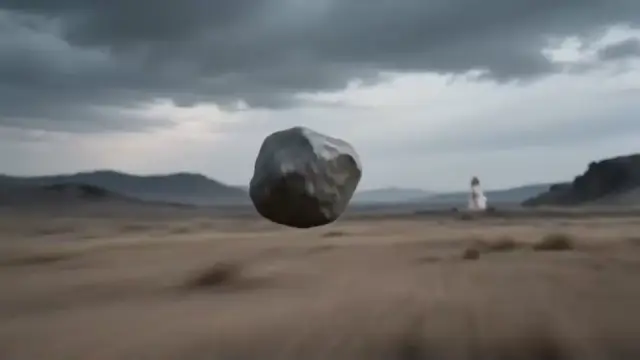
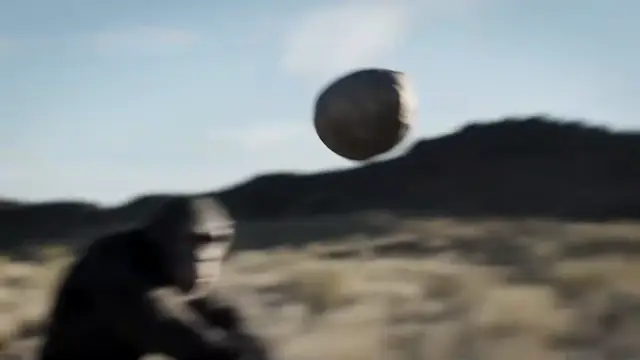
Begin in a dry prehistoric grassland with sparse beige plants, dusty ground, low dark hills, and a pale cloud-covered sky.

Show one dark-furred adult ape with a broad face, long arms, stable anatomy, and clearly separated hands and fingers. Use a low medium-close third-person camera positioned slightly in front of the ape.

The ape turns its torso, moves the right arm backward, grips one rough dark-gray stone, then swings the arm forward and releases the stone toward frame right. The shoulder, elbow, wrist, and fingers move in one connected throwing action.

The stone separates visibly from the hand with forward and slight upward momentum. The ape remains behind as the camera transfers attention to the released stone.

Phase 2 — Stone to spear:

Change to one lateral tracking camera that moves beside the stone.

Keep the stone large and sharply focused near the center-right of the frame. The prehistoric grassland passes rapidly behind it in shallow focus. The stone rotates slowly around its travel axis without reversing direction.

A short wooden shaft begins growing from the rear of the stone. The front of the stone narrows and extends forward. The rough round surface gradually becomes a triangular stone spearhead.

The shaft remains physically connected to the stone. The transformation occurs around the same moving center without stopping the projectile.

Phase 3 — Spear and ancient warfare:

The transforming stone becomes one complete flying spear with a wooden shaft and a triangular stone-and-metal point.

Continue the lateral tracking camera. Keep the spearhead in the same screen position and keep its point aligned with the direction of movement.

Crossfade the prehistoric grassland into a dusty ancient battlefield. Show a distant massed army, wooden defensive walls, raised flags, watchtowers, and suspended dust. Keep all people small and unfocused in the background.

Warm dusty daylight creates a thin bright highlight along the upper edge of the spearhead. The stone surface gradually becomes darker forged metal while the wooden shaft remains attached.

Phase 4 — Spear to bullet:

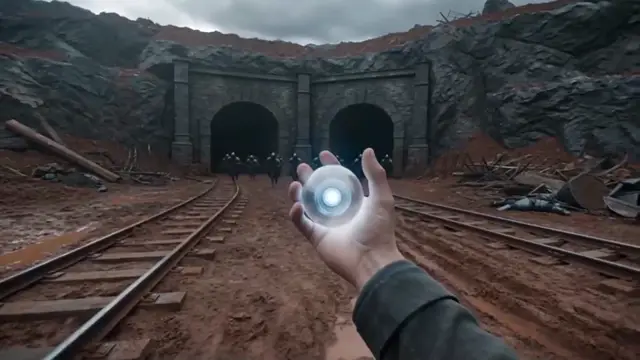
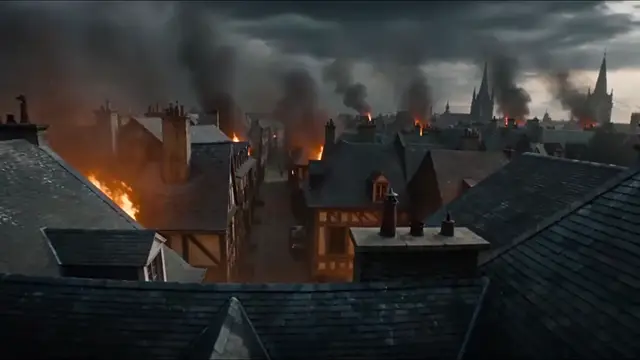
Transform the ancient battlefield into a gray industrial battlefield containing muddy trenches, broken wooden posts, damaged fences, smoke columns, orange fires, and distant explosions.

Keep the projectile moving in the same direction.

The wooden shaft retracts into the rear of the spearhead. The long triangular point contracts and becomes one compact copper-gray bullet. The surface changes from rough forged metal to manufactured metal with a rounded front and a circular rear.

Perform this transformation around the same moving center of mass. The bullet must inherit the spear’s velocity, forward axis, and screen position.

Use gray daylight mixed with orange fire reflections. Keep the bullet as the only sharply focused foreground object.

Phase 5 — Bullet to aerial bomb:

The bullet passes in front of a distant orange explosion.

Its body expands while remaining centered. The front becomes wider and rounded. The rear grows into a cylindrical body with four fixed, evenly spaced tail fins.

Complete the transformation into one dark olive aerial bomb with matte metal, visible panel seams, a rounded nose, and symmetrical fins.

At the same time, transition from the burning industrial battlefield into a green modern valley containing forested hills, distant mountains, and a blurred road below.

Orange firelight fades from the metal surface and is replaced by neutral daylight. The bomb continues forward without losing speed or changing direction.

Phase 6 — Bomb to fighter jet:

Keep the aerial bomb centered during the next transformation.

Perform one controlled camera movement around the transforming object, moving from a side profile to a frontal view.

Expand the rounded bomb nose into the nose of one original dark-gray single-seat stealth fighter. Transform the bomb body into the fighter’s fuselage. Extend two rigid symmetrical wings from the sides. Convert the tail fins into stable rear control surfaces. Form one transparent dark cockpit above the fuselage.

The completed fighter approaches the camera head-on while the camera retreats ahead of it. Show orange smoke behind the aircraft and a green mountain valley below.

The fighter then raises its nose and follows one continuous upward flight arc. The wings, cockpit, fuselage, and tail remain stable and symmetrical. Do not allow the aircraft geometry to melt after the transformation is complete.

Phase 7 — Fighter to orbital shuttle:

As the fighter climbs, move it into a dense layer of bright white clouds.

Let the clouds cover most of the frame and conceal the camera’s transition from a frontal position to a rear-following position.

As the aircraft emerges above the clouds, transform the fighter silhouette into one original orbital shuttle. Preserve the central fuselage, but enlarge the rear engine section and adjust the wings into a shuttle-shaped configuration.

Ignite one bright white-orange central engine plume. The plume points directly downward and backward along the craft’s travel axis.

Keep the rear-follow camera centered behind and slightly below the shuttle. The shuttle continues climbing through the upper atmosphere. White clouds fall below, the sky darkens, and Earth’s curved blue horizon becomes visible.

The shuttle crosses into black space without changing direction or drifting sideways.

Phase 8 — Shuttle to futuristic spacecraft:

Keep the camera directly behind the shuttle in low Earth orbit.

Show Earth below with a thin blue upper-atmosphere rim, scattered city lights on the night side, and soft reflected blue light on the lower surface of the craft. Show a black star field, a faint diagonal galaxy band, and two distant crescent celestial bodies.

Transform the shuttle’s circular rear engine into the central module of one large original futuristic spacecraft.

Expand the central fuselage backward and sideways. Unfold symmetrical structural sections from both sides. Form matching left and right engine assemblies with several rectangular exhaust ports. Add small fixed red navigation lights to the rear hull.

Every component must grow from an attached section of the shuttle. Keep the left and right structures symmetrical. Do not introduce detached parts or additional spacecraft.

Maintain the same forward travel axis and centered screen position during the transformation.

Phase 9 — Departure into deep space:

Complete the spacecraft with one central dark-metal fuselage, symmetrical engine assemblies, attached side structures, fixed red navigation lights, and multiple rectangular thrusters.

All blue-white thrusters ignite simultaneously. The engine light increases from dark blue to bright blue-white without changing the spacecraft’s shape.

Change to a wide locked rear view. Keep Earth’s curved horizon stable across the lower part of the frame.

The spacecraft accelerates directly away from the camera. Its angular size decreases continuously according to distance. The thruster lights remain visible while becoming smaller and less intense.

Keep the spacecraft centered above Earth. Keep the two crescent celestial bodies and faint galaxy band fixed in the background.

The spacecraft gradually becomes a small distant blue point moving deeper into space.

Physical continuity:

Preserve continuous cause-and-effect motion throughout the complete sequence.

The ape’s arm acceleration causes the stone’s release. The stone’s forward momentum continues through the spear, bullet, bomb, fighter, shuttle, and spacecraft transformations.

During every transformation, preserve:
- the moving object’s center of mass;
- forward direction;
- velocity vector;
- travel axis;
- screen position;
- rotation where visible;
- scale continuity;
- material continuity until the replacement material has formed;
- attached parts and symmetrical geometry.

Allow speed changes only when caused by visible propulsion, aerodynamic movement, gravity, or engine ignition.

Camera sequence:

1. Low medium-close third-person view of the ape.
2. Lateral tracking beside the stone, spear, bullet, and bomb.
3. Controlled transition from side profile to frontal tracking during the bomb-to-fighter transformation.
4. Front-facing tracking camera ahead of the fighter.
5. Cloud-covered transition to a centered rear-follow camera behind the shuttle.
6. Centered rear-follow camera during the spacecraft transformation.
7. Wide locked rear view during the final departure.

Lighting progression:

Begin with pale cool daylight over the prehistoric grassland.

Change to warm dusty sunlight above the ancient army.

Use desaturated gray daylight mixed with orange firelight over the industrial battlefield.

Change to neutral daylight over the green modern valley.

Use bright diffuse white light inside the cloud layer.

In space, use blue reflected Earth light on the lower hull, small red navigation lights, bright white-orange shuttle exhaust, and blue-white spacecraft thrusters against a black background.

Audio:

Use no dialogue or narration.

Begin with low wind and a restrained low-frequency musical pulse.

Synchronize one short air movement sound with the ape’s throw.

Add material-transformation accents when stone becomes metal, the spear becomes a bullet, and the bullet expands into a bomb.

Add distant battlefield impacts and fire during the industrial phase.

Introduce a rising jet-engine sound during the fighter transformation.

Transition into a deeper rocket-engine sound as the shuttle climbs through the atmosphere.

Add a mechanical expansion sound when the spacecraft unfolds.

Synchronize the strongest low-frequency sound with the simultaneous ignition of the spacecraft thrusters.

Reduce the engine intensity and music volume as the spacecraft recedes.

Final frame:

Earth’s stable curved blue horizon remains across the lower frame. The spacecraft is a small centered blue light moving away into deep space. The star field, faint galaxy band, and two crescent celestial bodies remain visible. No new subject, transformation, camera movement, or event begins after this state.

Follow this order exactly: ape, stone, spear, bullet, aerial bomb, fighter jet, orbital shuttle, futuristic spacecraft.

One ape at the beginning and one transforming foreground object in every later phase.

No additional apes, people, stones, spears, bullets, bombs, aircraft, shuttles, or spacecraft.

No duplicated object, missing phase, repeated phase, reversed transformation, teleportation, unexplained disappearance, sudden stop, backward motion, sideways jump, or unmotivated speed change.
- model
- Seedance 2
- type
- video
- shape
- 16:9
- length
- 15 seconds
- prompt
- 1,759 words
Made this? Fix the credit or remove it.