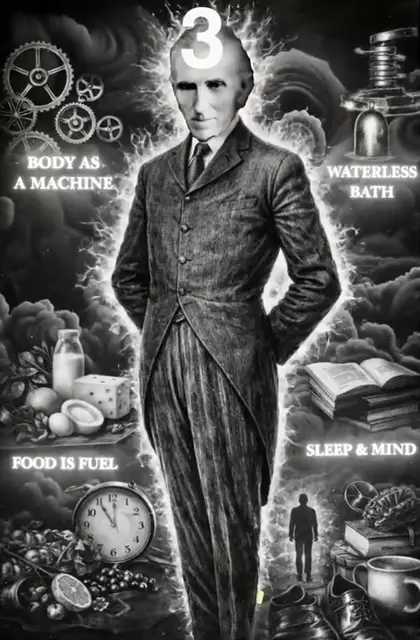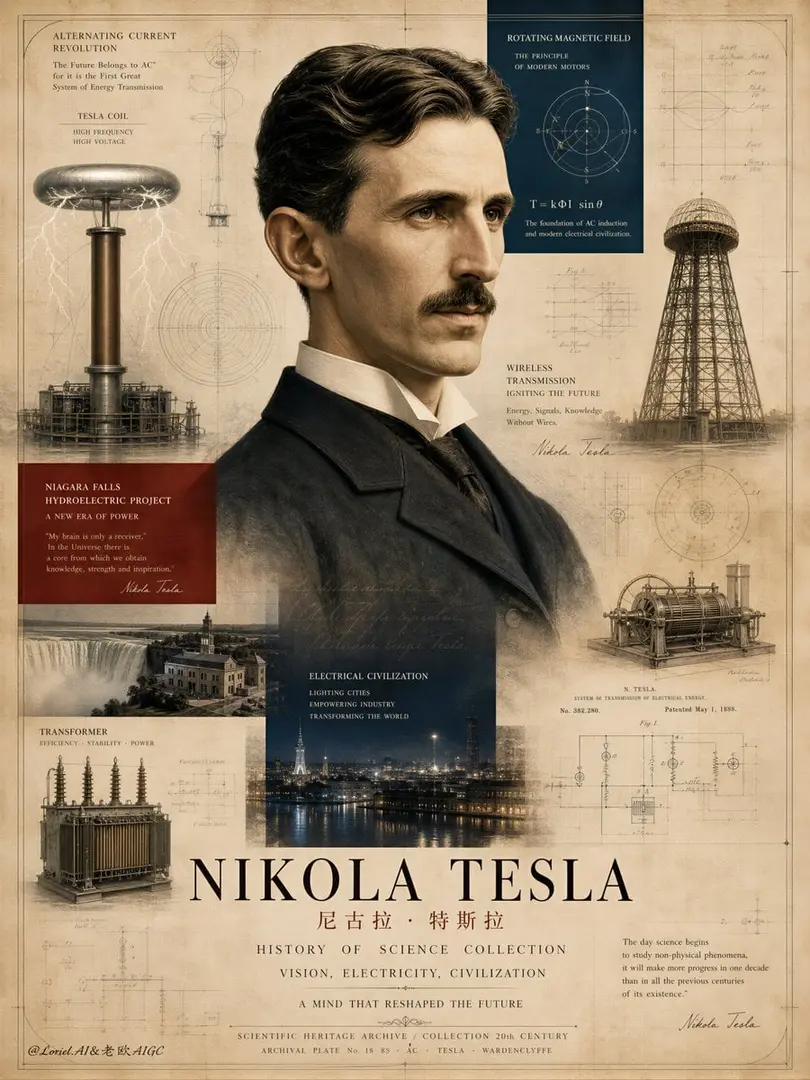
Nobel-level Nikola Tesla science poster
GPT Image 2 image prompt by Loriel.AI · original post
A prompt for creating a premium commemorative poster of Nikola Tesla for a history of science exhibition.
the prompt
Create an ultra-premium Nobel-level history-of-science poster dedicated to Nikola Tesla, designed as a monumental commemorative exhibition print honoring one of the most visionary minds in modern civilization. The image must combine a hyper-real historical portrait of Nikola Tesla with documentary scientific achievements, museum-grade composition, refined editorial geometry, delicate archival drawing integration, and extremely clean watercolor-fade transitions. The overall atmosphere should feel intellectually grand, historically consequential, culturally permanent, and worthy of a world-class science history institution.

Use a vertical poster composition with a strong central structure and expansive archival negative space. The main visual anchor must be a hyper-real historical portrait of Nikola Tesla, shown in a dignified side profile or refined three-quarter profile, with historically precise facial features, formal late-19th-century attire, sharp yet calm gaze, and an aura of visionary intensity. Tesla must feel like a civilization-shaping figure, not merely a scientist in portrait form.

The core concept is:
Nikola Tesla as a world-historical architect of electrical modernity,
presented in the visual language of a Nobel-level scientific commemoration,
where portrait, invention, technical evidence, symbolic legacy, and the future of civilization converge into one refined intellectual monument.
The poster should feel like a global science-history institution honoring a mind that altered the direction of human progress.

Surround Tesla’s portrait with carefully curated visual evidence of his scientific legacy, such as:
Tesla coils,
alternating current systems,
wireless transmission concepts,
rotating magnetic field diagrams,
high-voltage discharge studies,
transformers,
power-grid symbolism,
Niagara hydroelectric references,
laboratory apparatus,
and refined engineering document fragments.
These elements must feel documentary, historically grounded, and curated with academic authority, never random or decorative.

Introduce a few strong editorial geometry blocks behind and between the historical/scientific material:
deep slate blue,
burnt red,
charcoal,
and muted graphite panels,
arranged with exhibition-level discipline.
These geometric forms should feel like the visual architecture of a major science-history poster, providing balance, hierarchy, and modern monumentality without overwhelming the portrait.

The blending style is essential:
the central portrait and principal invention elements must be hyper-real, highly legible, and evidence-based,
while the surrounding transitions soften into archival paper tone,
faint technical drawing marks,
sketch-based invention studies,
and pale watercolor-like atmospheric fading.
The overall composition must remain extremely clean, precise, and culturally elevated.
No messy montage, no decorative splashes, and no sensational visual chaos.

The background should feel like premium archival exhibition paper:
aged ivory,
fine museum grain,
faded parchment,
subtle document texture,
and calm intellectual breathing room.
Add understated background details such as:
faint scientific drafting lines,
calculation grids,
catalog alignment marks,
archival registration traces,
museum plate framing,
and technical notation overlays.
These details should feel subtle, rigorous, and prestigious.

The scientific achievement imagery should not only record invention, but suggest historical consequence.
Include supporting visual language that implies:
the birth of electrical civilization,
the emergence of power systems,
the transformation of cities through electricity,
the future promise of energy transmission,
and the bridge between laboratory discovery and planetary modernity.
These implications must remain refined and intellectually visualized, never turning into literal sci-fi fantasy.

Lighting must be extremely soft and elevated:
gentle museum-quality illumination,
calm sculptural highlights on Tesla’s face,
subtle tonal shaping on clothing,
faint atmospheric light around electrical invention elements,
and elegant shadow transitions across the archival surface.
The light must feel noble, contemplative, and globally prestigious, never theatrical or cheap.

Typography should follow a world-class scientific commemoration system.
Use:
main English title: “NIKOLA TESLA”
small Chinese subtitle: “尼古拉・特斯拉”
Optional supporting English lines:
“History of Science Collection”
“Vision, Electricity, Civilization”
“A Mind That Reshaped the Future”
Typography should be placed with strong curatorial discipline in the lower portion of the poster or integrated into the editorial structure. Use elegant serif or restrained institutional typography with refined spacing, scholarly hierarchy, and exhibition-grade authority.
You may include a subtle commemorative code, collection marker, or exhibition notation such as:
“Scientific Heritage Archive / Collection 20th Century”
or another refined archival identifier.
A minimal seal-like museum mark may appear only if extremely subtle.

Color palette:
aged ivory,
archival parchment,
soft graphite,
charcoal black,
burnt red,
deep slate blue,
faded steel gray,
and restrained pale electric-blue accents.
The palette must feel monumental, academic, and historically authoritative, with subtle energy symbolism but no excess.

The composition should evoke:
scientific greatness,
historical permanence,
civilizational impact,
museum authority,
intellectual monumentality,
and collectible exhibition beauty.
Everything must feel precise, calm, elevated, and worthy of international scientific memory.

Rendering style:
hyper-realistic historical portrait poster, Nikola Tesla Nobel-level science history tribute, museum-grade archival exhibition design, documentary invention collage, refined editorial geometry, delicate watercolor fade, subtle pencil-sketch integration, scholarly commemoration typography, world-class scientific heritage aesthetic, 8k, museum-quality visual excellence.

Negative prompt:
cheap educational poster, cartoon scientist, messy collage, random sci-fi fantasy, cyberpunk overload, low-detail face, generic old man portrait, cluttered lab props, loud typography, over-saturated colors, comic-book electricity, fake historical costume, noisy background, low-end print design, decorative excess
- model
- GPT Image 2
- type
- image
- shape
- 3:4
- shared
- July 10, 2026
- prompt
- 801 words
Made this? Fix the credit or remove it.